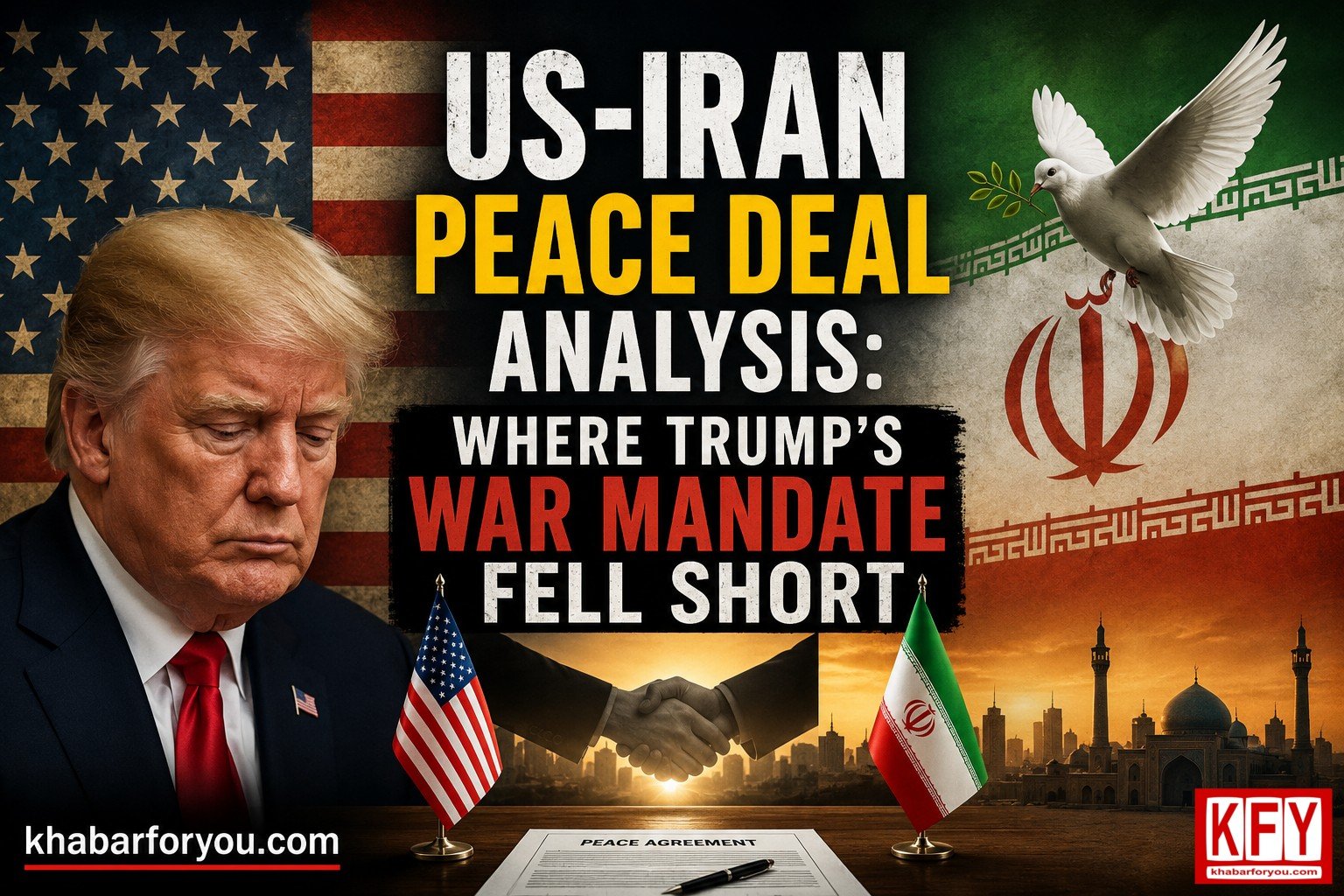
US-Iran Peace Deal Analysis: Where Trump’s War Mandate Fell Short | Khabar For You
- Khabar Editor
- 18 Jun, 2026
- 99749
Email:-infokhabarforyou@gmail.com
Instagram:-@khabar_for_you

In an unexpected diplomatic turn that has reshaped the geopolitical landscape of the Middle East, US President Donald Trump has officially signed a comprehensive 14-point memorandum of understanding (MoU) with the Islamic Republic of Iran. The historic pact, executed on the sidelines of the G7 Summit in France, marks the formal cessation of a grueling three-month-long military conflict that brought the global economy to its knees and pushed international energy markets into an unprecedented crisis.
However, as the ink dries on the Versailles agreement, an intense global post-mortem has begun. While President Trump declared the deal a "monumental triumph" that eliminated Israel’s "biggest risk," a closer examination of the 14-point memorandum reveals a stark disconnect between Washington’s initial, maximalist war objectives and the concessions ultimately granted to Tehran. From demands of outright regime change to the total dismantlement of Iran's nuclear architecture, the United States has fallen significantly short of the goals it outlined at the onset of hostilities in February.
Read More - NEET-UG 2024 Controversy: NTA Re-Exam for 1,563 Students & Paper Leak Probe | KhabarForYou
The Initial Calculus: What Trump Promised
When the joint US-Israeli military campaign was launched earlier this year, the Trump administration framed the intervention not as a limited skirmish, but as a definitive campaign to permanently alter the balance of power in West Asia. The White House explicitly laid down three core pillars of its military mandate:
1.Regime Overthrow: Dislodging the clerical establishment in Tehran and transitioning Iran toward a Western-aligned governance structure.
2. Absolute Nuclear Cessation: The total and irreversible destruction of all uranium enrichment facilities, centrifuges, and research laboratories.
3.Military Neutralization: Systematically dismantling the Islamic Revolutionary Guard Corps (IRGC) and stripping Iran of its ballistic missile and asymmetric warfare capabilities.
In an hour-long press conference ahead of the signing ceremony, President Trump maintained a characteristically aggressive posture, warning Tehran that "if talks fail, the US could launch bombs again." He later communicated directly with Israeli Prime Minister Benjamin Netanyahu, telling him, "Think of it, Bibi. You got the best."
Yet, strategic analysts point out that while parts of Iran’s conventional military infrastructure suffered heavy damage during the 90 days of intense aerial bombardment, the broader political and nuclear goals of the war have effectively dissolved.
Where Washington Fell Short: The Anatomy of Concessions
The definitive proof of Washington's compromised position lies within the text of the 14-point MoU itself. Far from an unconditional surrender, the document outlines an arrangement that guarantees the survival of the Iranian state apparatus.
1. The Survival of the Islamic Republic
The most glaring omission in the treaty is any mention of electoral reform, leadership oversight, or changes to the Islamic Republic's constitution. For an administration that openly sought a veto power over who would succeed as Iran's next Supreme Leader, the final deal represents a complete retreat. The clerical regime, which has governed since the 1979 revolution, emerges from the war with its sovereignty intact and its political system unchallenged by international mandates.
2. The Nuclear Compromise and the 60-Day Clock
Instead of the immediate termination of Iran’s nuclear program, the treaty establishes a 60-day negotiation window. During this period, the US and Iran will engage in bilateral talks regarding the future scope of the Iranian nuclear program and the disposal of its heavily enriched uranium stocks. By failing to secure immediate denuclearization, the US has essentially kicked the problem down the road, leaving Iran's domestic technical know-how intact.
3. Financial Reversals and the $300 Billion Reconstruction Fund
Perhaps the most controversial aspect of the Versailles Accords is the economic relief package secured by Iranian negotiators. Under the terms of the deal:
The United States will immediately lift its naval blockade on Iranian ports, enabling the unrestricted transport and sale of Iranian crude oil to global markets.
Washington has committed to sweeping sanctions relief and the immediate release of tens of billions of dollars in frozen Iranian foreign assets.
Most surprisingly, the final text includes a provision for a $300 billion international fund dedicated to rebuilding the war-torn Islamic Republic.
While US Vice President JD Vance swiftly moved to manage domestic fallout - stating that the reconstruction capital would be funneled primarily from Gulf cooperation nations rather than US taxpayers - the reality remains that Tehran is set to receive massive financial inflows. Vance noted that these investments would remain under strict oversight by Gulf states, conditional upon whether "Iran starts to behave like a normal country."
The Strategic Battle for the Strait of Hormuz

The Strait of Hormuz, a critical geopolitical chokepoint, which Iran must reopen under the new 14-point deal.. Source: rbkomar / Getty Images
A critical flashpoint in the negotiations centered on the world's most vital maritime oil chokepoint: the Strait of Hormuz. The war-induced closure of the strait had triggered an energy crisis that crippled European and Asian manufacturing sectors.
The treaty dictates that Iran must fully reopen the Strait of Hormuz within 30 days, ensuring that commercial maritime traffic returns to pre-war volumes. However, a hidden clause has raised alarms in Asian capitals, particularly New Delhi and Beijing. The MoU stipulates that Iran must maintain an unhindered, restriction-free passage through the strait for an initial 60 days. Crucially, the wording does not rule out the imposition of future maritime tolls by Tehran.
Historically a free-transit passage, the physical damages inflicted upon Iranian coastal infrastructure during the war are now being leveraged by Tehran as a justification to implement a permanent toll system to recoup its economic losses. If enacted, this will fundamentally alter global shipping economics.
Domestic Backlash: A Fractured Washington
The publication of the draft memorandum has triggered a political firestorm in Washington, leaving Capitol Hill deeply divided.

The Geopolitical Fallout
Ultimately, the Versailles Accords highlight the stark limits of modern kinetic warfare against deeply entrenched regional powers. By failing to secure a definitive political overhaul in Tehran or immediate nuclear dismantlement, the United States has traded its initial grand strategy of maximum pressure and regime change for a pragmatically managed exit.
For Iran, the deal offers an existential lifeline: an end to a devastating blockade, the retrieval of frozen capital, and a seat at the negotiating table with its political structures fully preserved. As the 60-day nuclear clock begins to tick, the international community remains skeptical as to whether this pact will truly bring lasting stability to West Asia, or simply mark a temporary pause before the next inevitable conflagration.
© 2023 Khabar For You. All Rights Reserved.
Business, Sports, Lifestyle ,Politics ,Entertainment ,Technology ,National ,World ,Travel ,Editorial and Article में सबसे बड़ी समाचार कहानियों के शीर्ष पर बने रहने के लिए, हमारे subscriber-to-our-newsletter khabarforyou.com पर बॉटम लाइन पर साइन अप करें। |
| यदि आपके या आपके किसी जानने वाले के पास प्रकाशित करने के लिए कोई समाचार है, तो इस हेल्पलाइन पर कॉल करें या व्हाट्सअप करें: 8502024040 |
#KFY #KFYNEWS #KHABARFORYOU #WORLDNEWS
नवीनतम PODCAST सुनें, केवल The FM Yours पर
Click for more trending Khabar
Leave a Reply
Your email address will not be published. Required fields are marked *
Search
Category